Universal Design of Learning
and
Universal Design
“Consider the range of user abilities at the design stage of the curriculum and plan for accommodations…”
CASE, 2003
As you walk into a building the doors open via a sensor or the ADA push button and the doors open. Or you are waiting at the crosswalk reading and you hear the voice-over crosswalk recording to “walk.” There are many examples we use daily that derived from the principles of Universal Design (UD). I have known accessibility has been put in place for people that need support, but after going over the 7 principals of UD (The Center of Universal Design, 1997) I began to notice I rely on it often. For example, I use the ADA push button, I prefer to use ATM’s & screens with visual cues, the friendly use of instruction manuals for furniture I’ve built, audio cues at sidewalks, the undo feature on my phone, automated soap dispenser in restrooms, and I certainly love spacious aisles at grocery stores. I have personally used many of them to ease my daily life, but I have unintentionally relied on them. Usually I’m focused on my son and prompting him to be safe as we wait for the light to change. I do not always look at the crosswalk light and I rely on the recording to “walk” and redirect my son to cross the street.
Our students are like fingerprints; no one student is the same, and there is learner variability within our students. They have different personalities, ways to communicate, learning styles and backgrounds; it is essential we keep in mind each students’ strengths and challenges to support in their success. Similarly, as a learner myself I work on yearly instructional modules as part of work to enhance knowledge, tools, information, and updated regulations to better support my students
Some examples on the online instructional modules I see are interactive examples for engagement, ability to go back or forward in the modules to self-regulate, multiple means of learning with text, visual images, videos, and interactive examples. In addition, the modules provide representation through key word definitions, illustrations in visual images and videos that range in length with closed caption subtitles, and guidance to the structure of module of what will be learned and objectives of modules. Furthermore, the modules provide action & expression through quizzes as a means of progress monitoring, multiple media usage through videos, interactive examples and videos, images that support critical thinking, and text recognition, typically the modules are read aloud.
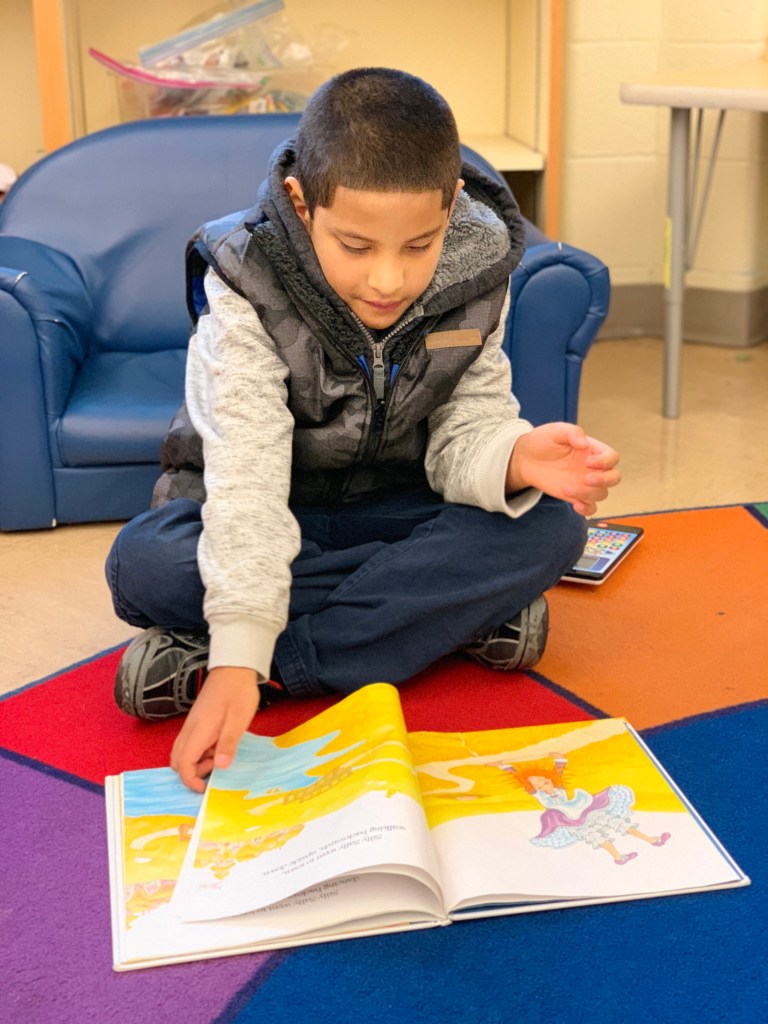
UD and UDL have similarities but also have differences. In the example of the stairs, people that are not able to independently walk up the steps can engage in reaching the top through the ramp. In UDL, successful planning implements the inclusion of diverse resources to support students with various abilities to engage, represent, and provide action & expression. See Adrian’s picture on this blog, Adrian started with board books as he developed motor skills to flip through the book without ripping the pages. Using the zone of proximal development (ZPD), upon his success to flip through the pages of the book independently, I supported him with hardcover books. Upon his achievement in the use of a hardcover books, then, he transition to paperback-books. The practice of various supports can support in engagement, as well as sensory friendly books that support in representation, and journals where students can be involved in action & express themselves. Books are important at any stage of life and can be supported in planning of UDL curriculum. The British educator, Sir Ken Robinson, said the key to education is to personalize it by building with the individual’s strengths and can naturally discover their passions (Meyer, Rose, & Gordon, 2014).
Some examples from the readings that I connected to my environment was reviewing chapter one in UDL Theory & Practice – that UDL reduces barriers, provides context and self-awareness, and support to engage, represent and provide action and expression to students. In addition, the YouTube video emphasize on students who are marginalized and underserved, such students include English Language Learners, disabilities, and gifted and talented. UDL provides the ability to plan for all of your students to meet them at their zone of proximal development and support them to reach their potential (National Center on Universal Design for Learning, 2010).
References:
The Center for Universal Design. (1997, April 1). The Principals of Universal Design. North Carolina State
University. Center for Universal Design, College of Design.
https://projects.ncsu.edu/ncsu/design/cud/pubs_p/docs/poster.pdf
Case, B. J. (2003). Policy Report: Universal Design. Pearson Education, Inc.
Meyer, A., Rose, D. H., & Gordon, D. (2014). Universal Design for Learning: Theory and Practice. Wakefield, MA:
CAST Professional Publishing.
National Center on Universal Design for Learning. (2010, March 17). UDL Principles and Practice [Video].
YouTube. https://youtu.be/pGLTJw0GSxk


Yvonne,
You made a lot of great points, about the items we used every day. I hadn’t even though of books being Universally Designed. The modifications to our environment are done so consistently now, that one doesn’t really think about the design until you are looking for it. It honestly never would have crossed my mind to think about the structure of books, covering until you mentioned it. What a great point though, modifications are all around us, and many of us take them as second nature now at this point. I did have to chuckle a bit as you referenced the talking crosswalk. This public service announcements, that have encompassed more urban areas, have not quite made it to my rural neck of the woods, and I am still quite actively completing the left right left action no matter what the hand signal light is telling me to do. I think I confuse the flow of traffic whenever I visit an urban area.
I agree with the importance of meeting the students where they are. Universal Design for Learning seems a great way to meet them not only where they are, but to provide a means of getting them where they are going, and beyond as it instills the ability to become expert learners.
Great post !
Regards,
Jeannine
LikeLike
Hi Jeannine,
Oh my don’t think I dive right into traffic when I hear the automated recording to walk, haha. I still look both ways, but it does help me interact with my son that minute to discuss safely crossing the street. Glad I made you chuckle a bit. Yes, the variability of books can be supported for users. I have to agree with you, the modifications are second nature to us, and we do not think about why designs are the way they are. Instead, I think most of use feel a relief of friendly use designs. I can only imagine that our ease of use is also a relief to people who need those modifications.
LikeLike
Ivonne,
I loved your statement: “Our students are like fingerprints; no one student is the same, and there is learner variability within our students.” I think you really show the diversity of people’s needs in your post and emphasize how the differences in universal design and UDL can impact that learning.
LikeLike
Hi Monica,
Thank you, I think its important to remember that our students are different, and while some behaviors, learning styles, or even characters may resemble past or current students, there are still differences and variability between them.
LikeLike
Nice summary Ivonne. I love the personal connection that you shared here and how you’ve used different books to scaffold the learning for this young man. Wonderful example! Yes, we have many examples of universal design in our environments today. I tend to see many of these when I fly as airports often have closed-captioning on with the television monitors, the bathrooms have motion sensing faucets and toilets, audio commands are sometimes at walkways and on elevators, and signage is available for those with vision disabilities. As you noted, all of these universal designs help many more than just those in the “margins” and the original intended benefactors.
LikeLike
Hi Professor Smith,
Thank you for your positive feedback, I greatly appreciate it. I’m so glad you mentioned the airport, I have noticed more universal designs in my every day life, but also places like the airport that a user might not frequent the use, but it has daily activity of various user abilities. In addition, I’m also noticing more ability variability in learning methods. I had professional development today and while UDL was not mentioned, it certainly had all the components of multiple means of engagement, representation, and action & expression I am beginning to see how UDL is implemented in trainings, education, and other forms of learning to support students.
LikeLike
Arent’ you glad about learning about Universal Design and UDL. I feel like this is knowledge that I should’ve learned a long time ago.
LikeLike